Kilowatt Blueprint earns referral commissions from qualifying purchases made through external merchant links at no additional cost to you. How Kilowatt Blueprint is funded
Choosing an EcoFlow portable power station comes down to two continuous electrical metrics: how much total energy you need to store (measured in watt-hours, or Wh) and the continuous wattage your appliances draw (measured in watts, or W). EcoFlow segments its hardware into two distinct model lines. The RIVER series targets mobile field tasks, vehicle camping, and camera or drone setups where weight takes precedence. The DELTA series provides high-wattage inverters and multi-kilowatt-hour capacities suited for heavy kitchen appliances, power tools, and extended domestic blackout mitigation.
Because portable power stations are substantial investments, selecting between a sub-20-pound companion like the RIVER 2 Pro and a high-capacity unit like the DELTA 3 or DELTA 3 Max depends on the continuous operating limits of your gear rather than surge peak claims. For a wider industry look at how load requirements dictate sizing, explore our comprehensive guide on how to choose a portable power station by capacity, output, and portability.
Always size the unit’s rated continuous AC output above the running wattage printed on your equipment's manufacturer label. While EcoFlow's proprietary X-Boost technology allows certain resistive loads (such as heating elements) to operate at reduced power without tripping the circuit, sensitive electronics, compressors, and motor-driven tools require full, unthrottled continuous inverter headroom.
EcoFlow Hardware Tiers: RIVER vs. DELTA
EcoFlow utilizes Lithium Iron Phosphate (LiFePO4 or LFP) cell chemistry across its modern product catalogs, including the RIVER 2 lineup and third-generation DELTA units. LFP chemistry offers extended cycle lifespans compared to older nickel-manganese-cobalt (NMC) packs, with seller and manufacturer listings typically advertising over 3,000 cycles before the battery degrades to 80% of original capacity.
Understanding which model family meets your workflow requires evaluating trade-offs between physical mass, battery capacity, inverter output, and replenishment speed.
1. Mobile Utility Tier: EcoFlow RIVER 2 Pro
The RIVER series focuses on transportability. Listed with a 716Wh capacity and an 800W continuous pure sine wave inverter, the RIVER 2 Pro is engineered for basecamps, mobile tech stations, and light refrigeration. Seller specifications cite a net weight of approximately 17.2 lbs (7.8 kg), making it realistic for single-hand carry over moderate distances.
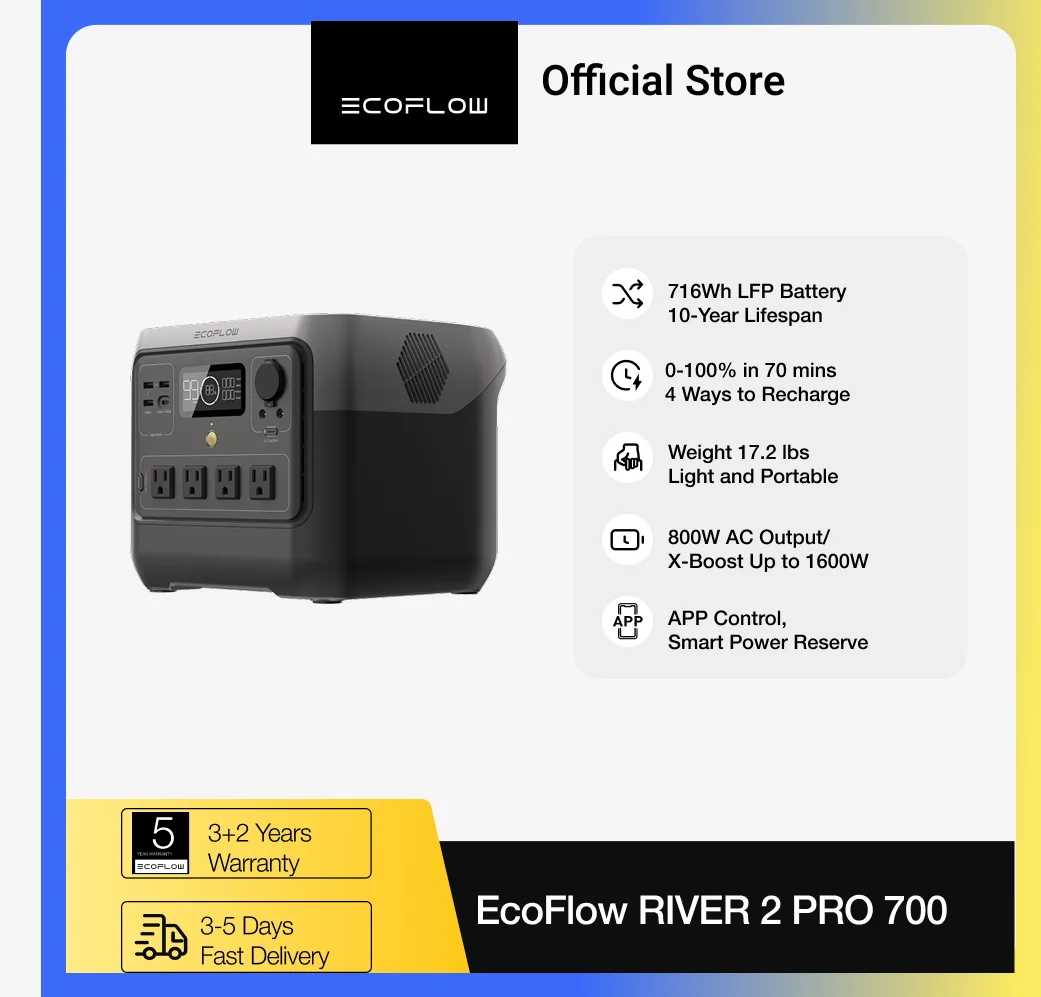
Seller claims for this unit cite an AC fast-charging time of 0 to 100% in roughly 70 minutes. While its 800W output easily handles laptops, starlink terminals, CPAP machines, and small blending appliances, it will not operate high-draw heating appliances like standard drip coffee makers or electric space heaters unless X-Boost steps down the voltage. For users seeking ultra-compact sub-600W outputs or low-wattage DC efficiency, newer compact iterations like the EcoFlow RIVER 3 series offer alternative configurations designed specifically around micro-UPS applications and small footprint transport.
2. The Mid-Tier Standard: EcoFlow DELTA 3 (1024Wh)
Stepping into the DELTA platform provides a substantial boost in inverter capability. The standard DELTA 3 (Classical Dark 1000 listing) incorporates a 1024Wh capacity paired with an 1800W continuous AC output. This inverter class covers roughly 90% of household kitchen appliances, small microwave ovens, and corded circular saws without requiring voltage suppression.
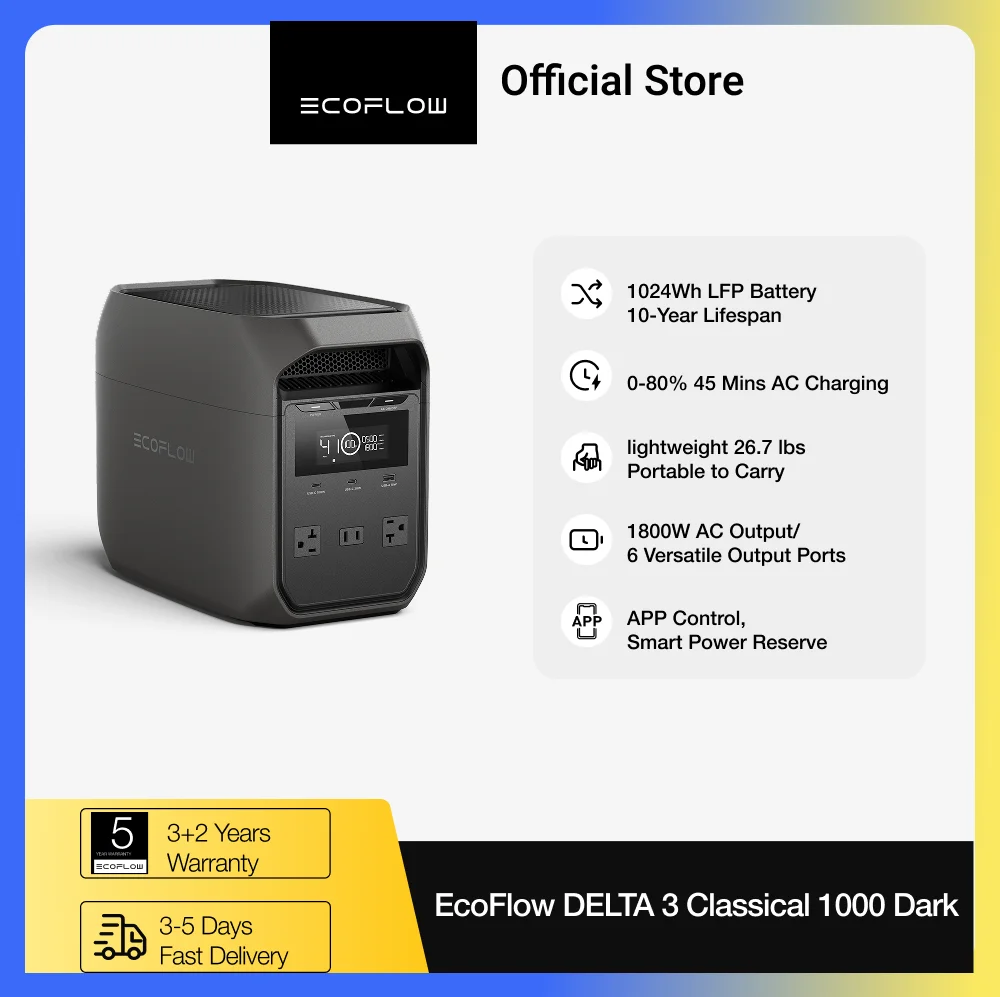
According to EcoFlow DELTA 3 specifications, the unit features automotive-grade full-tab LFP cells and an integrated uninterrupted power supply (UPS) switchover mode rated at under 10 milliseconds. Seller listings state the 26.7-lb station can recharge from 0 to 80% in approximately 45 minutes via wall AC power. This speed is especially valuable during intermittent rolling blackouts or brief generator run cycles. However, at nearly 27 lbs, carrying the DELTA 3 on foot requires deliberate effort compared to the lighter RIVER line.
3. High-Capacity Field & Backup: EcoFlow DELTA 3 Max
For high-draw field operations, job sites, or multi-day domestic refrigeration, the DELTA 3 Max represents the heavy-duty bracket of the portable spectrum. Featuring a 2048Wh battery bank and an advertised continuous inverter output of 2400W (with seller-claimed X-Boost output reaching up to 3400W), this unit can power heavy heating tools, induction cooktops, or commercial air compressors.
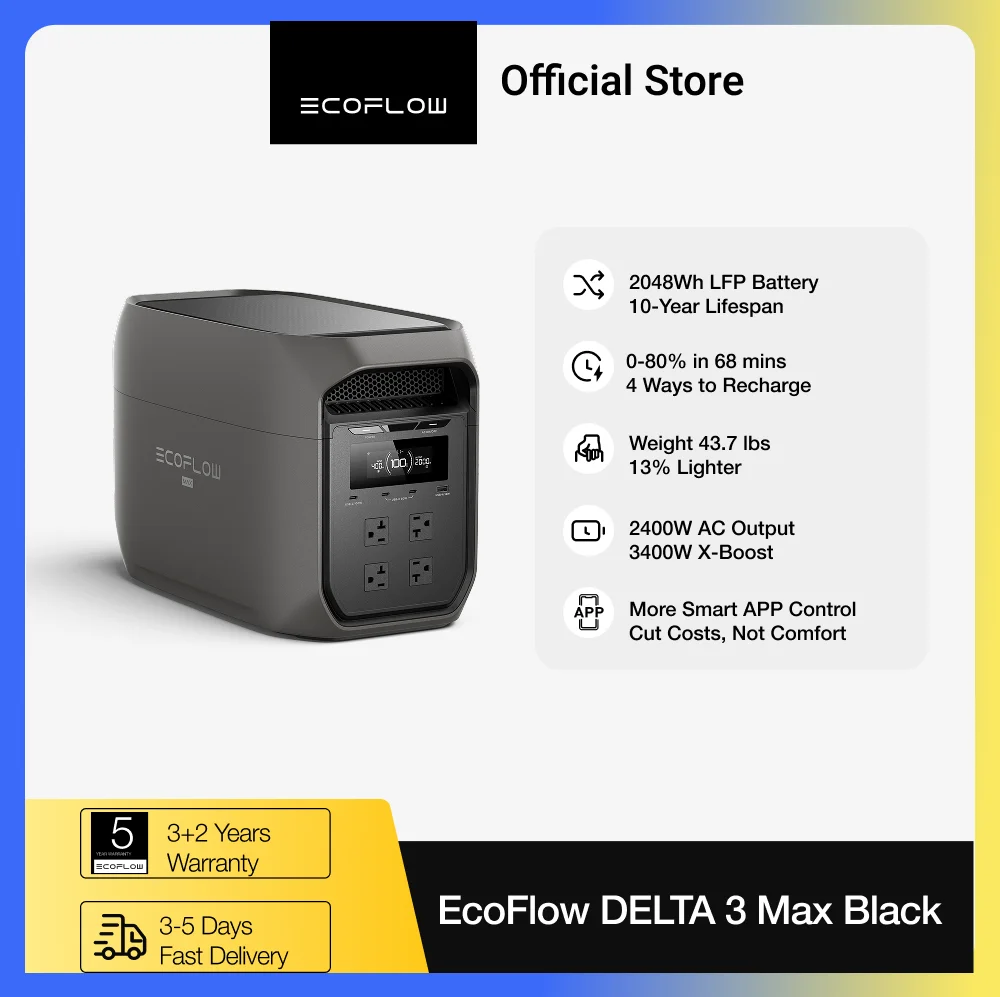
The marketplace listing indicates an ultra-fast AC replenishment time from 0 to 80% in approximately 68 minutes (1.13 hours), alongside a seller-reported mass of 43.7 lbs. Due to the substantial weight of a 2kWh lithium iron phosphate pack, the DELTA 3 Max is primarily designed for vehicle storage, RV lockers, workshop carts, or fixed home utility closets.
The DELTA 3 Max listing referenced here is offered by a third-party seller (Shop1105233629 Store) bundled with an auxiliary 20W charger. When purchasing high-tier electrical equipment through secondary merchant storefronts, always verify the exact package contents, warranty registration terms, and return guarantees directly on the checkout invoice.
Direct Specification Comparison
The following table summarizes the seller-advertised hardware specifications and performance metrics across the three featured models.
| Hardware Model | Advertised Battery Capacity | Continuous AC Output | Stated Unit Weight | Advertised Fast AC Charge Rate |
|---|---|---|---|---|
| RIVER 2 Pro | 716Wh (LFP) | 800W (X-Boost to 1600W) | 17.2 lbs (7.8 kg) | 0–100% in ~70 mins |
| DELTA 3 (Classical 1000) | 1024Wh (LFP) | 1800W (6 ports advertised) | 26.7 lbs (12.1 kg) | 0–80% in ~45 mins |
| DELTA 3 Max | 2048Wh (LFP) | 2400W (X-Boost to 3400W) | 43.7 lbs (19.8 kg) | 0–80% in ~68 mins |
*Data compiled from seller listing claims and EcoFlow product specifications captured October 2026. Charging figures reflect wall AC inputs under optimal ambient temperatures.
Essential Decision Factors Before Buying
As documented in EcoFlow's technical overviews of the DELTA platform, selecting an off-grid battery requires evaluating more than just headline capacity figures. Keep these practical factors in mind:
1. Understanding Inverter Overhead and DC Parasitic Loss
A power station's rated watt-hour capacity does not translate into 100% usable electricity at the plug. The internal AC inverter consumes steady standby power simply being switched on (often between 15W and 30W depending on the model tier). Furthermore, DC-to-AC conversion incurs an efficiency loss typically ranging between 10% and 20%.
- DC Utilization (USB-C, 12V Car Sockets): Highly efficient (~85–90%), ideal for routers, mobile phones, and portable camping fridges running directly on 12V DC cables.
- AC Inverter Utilization: Incurs higher parasitic overhead. Running a low-wattage (e.g., 20W) device through a standard wall plug on a 2000Wh battery will deplete the unit faster than expected due to inverter idle consumption.
2. Surge Demands vs. Running Demands
Inductive loads containing electric motors or compressors—such as portable air conditioners, sump pumps, and full-sized refrigerators—demand an initial surge wattage that can be double or triple their steady running draw. Ensure the unit's instantaneous surge rating comfortably exceeds the peak motor-start rating indicated in your appliance’s service manual.
3. Solar Replenishment Capabilities
If you plan to use an EcoFlow station off the grid for extended periods, check the unit's maximum solar input voltage (V) and amperage (A) limits. A 2048Wh power station like the DELTA 3 Max will require substantial solar array capacity (typically 500W to 1000W of compatible panels) to achieve a full single-day recharge under real-world sun conditions.
Pre-Purchase Checklist
Before completing an order for any portable battery generator on an open marketplace, review these steps to avoid configuration mismatches:
- Audit Your Appliance Wattages: Sum the continuous wattage of every critical item you intend to operate at the same time. Select a power station whose unassisted continuous inverter output exceeds that sum by at least 20%.
- Check AC Input Voltage Compatibility: Confirm that the power station model version matches your local grid voltage (e.g., 120V 60Hz in North America or 220–240V 50Hz in other regions) before ordering from international merchant listings.
- Verify Physical Dimensions and Weight: A 43.7-lb station requires two hands or a rolling cart. If your priority is quick trunk packing or carrying to a picnic bench, the 17.2-lb RIVER 2 Pro is considerably easier to manage.
- Review Delivery and Warranty Terms: Confirm shipping coverage to your zip code and whether the seller is an authorized EcoFlow outlet eligible for the full manufacturer warranty period.
Evaluation is based on published specifications and seller listings. No physical or hands-on testing was conducted; unlisted specifications may still be available from the seller.